[Template] What to Include in Social Media Screening Policies


Recent benchmark data reveals an alarming truth for corporate leadership: online misconduct signals have increased by 34% year-over-year. This highlights one of the biggest shifts in hiring and workplace management in the last few years. That corporate risk starts in digital spaces.
Employee risk management now requires a formal, proactive digital governance strategy that standard screening processes were simply never equipped to handle. From severe online harassment and explicit threats of violence to systemic intolerance and catastrophic leaks of company data, misconduct has migrated online. Since social media is the new workplace water cooler, online misconduct is shared publicly, permanently, and 24/7, well before it makes its way into the office.
Because today's candidates and employees treat social media like their personal diary, documenting their judgment, ethics, behavioral patterns, and work experiences online, the tools used to evaluate them need to be able to review behavior risks in those online spaces as well. Unfortunately, most organizations are still trying to safeguard a 2026 workforce using an outdated framework that misses social media entirely. To understand how this critical visibility gap leaves organizations exposed, we have to look closely at internal screening practices and guidelines.
What’s Wrong with Traditional Screening Policies?
The traditional background check was built for a 20th-century workforce. For decades, most standard screening policies included a few boxes to check: verifying employment history, confirming educational degrees, and running a criminal database search. If a candidate didn't have a formal record of an arrest or conviction, they were considered "low risk."
But now, relying on these outdated methods leaves a massive blind spot in talent acquisition and risk management strategies.
Traditional screening fails to address how people actually communicate, interact, and show up for work today. The modern workforce, composed of digital natives, Gen Z, and Gen Alpha, doesn't limit their interactions to the physical water cooler or office chatter. Instead, those conversations, behaviors, and dynamics have moved online to public social media networks, forums, and other digital spaces.
Traditional Screening vs. Modern Online Screening
- Traditional Check (Reactive) ─> Looks backward at formal records (Arrests, Convictions, Resumes)
- Modern Screening (Proactive) ─> Looks at identity and public behavior (Candidate Fraud, Harassment, Workplace Threats, Intolerance)
.png)
Because of this shift, employee misconduct and risk signals aren’t surfaced through legacy background checks in the same way that they used to be, completely missing modern identity concerns and digital behavior risks. A candidate or employee can exhibit a public pattern of severe online harassment, explicit workplace threats, or deep-rooted intolerance, behaviors that directly violate your company’s code of conduct and threaten workplace safety, yet still pass a standard background check with flying colors.
Gaps in Screening Criteria
Even when organizations recognize this gap and attempt to dive deeper into online behavior, their internal policies frequently fall short. Many legacy screening policies rely on vague, catch-all phrases stating that the company "reserves the right to review public social media profiles." However, this ambiguous approach leaves candidate tracking undefined while failing to satisfy FCRA and EEOC regulations. To stay compliant, corporate screening policies must document what’s being evaluated while filtering out personal lifestyle attributes. and isolate only job-related risk indicators that protect business continuity and reinforce the company's code of conduct.
Vague policies open the door to two major issues:
- Unconscious Bias: Without explicit boundaries, manual "Googling" by hiring managers leads to the exposure of protected class information (such as age, religion, sexual orientation, or medical history), which can subconsciously skew hiring decisions and trigger EEOC compliance violations. Similarly, attempting to use conversational AI tools like ChatGPT for manual screening poses identical bias risks, since public LLMs can’t redact protected characteristics or guarantee legal compliance.
- Lack of Consistency: A policy must protect the organization while remaining fair to the candidate. Defining the exact risk behaviors, such as explicit threats of violence, illegal acts, or severe harassment, ensures screening consistency across all candidates and employees.
“Higher education institutions face immense public pressure and oversight. Ensuring the best placements requires more than traditional background checks, which often miss behavioral patterns visible only on social media or the web. Before Fama, the team tried to surface these insights manually through Google and LexisNexis searches. These were time-consuming and lacked the depth and consistency required for executive-level roles. Failing to catch a past controversy would impact the trust that universities place in Academic Search to vet candidates thoroughly.”
- Excerpt from Fama Case Study: Modern Due Diligence in Higher Education Executive Search
A modern social media screening policy must be a structured, transparent extension of your corporate code of conduct, explicitly mapping digital behaviors to real-world workplace standards.
4 Key Pillars of a Social Media Screening Policy
A modern social media screening policy is a careful balance between risk mitigation, candidate fairness and data privacy, and legal compliance. To stay protected while respecting candidate and employee rights, a corporate social media screening policy needs to be supported by four foundational pillars.
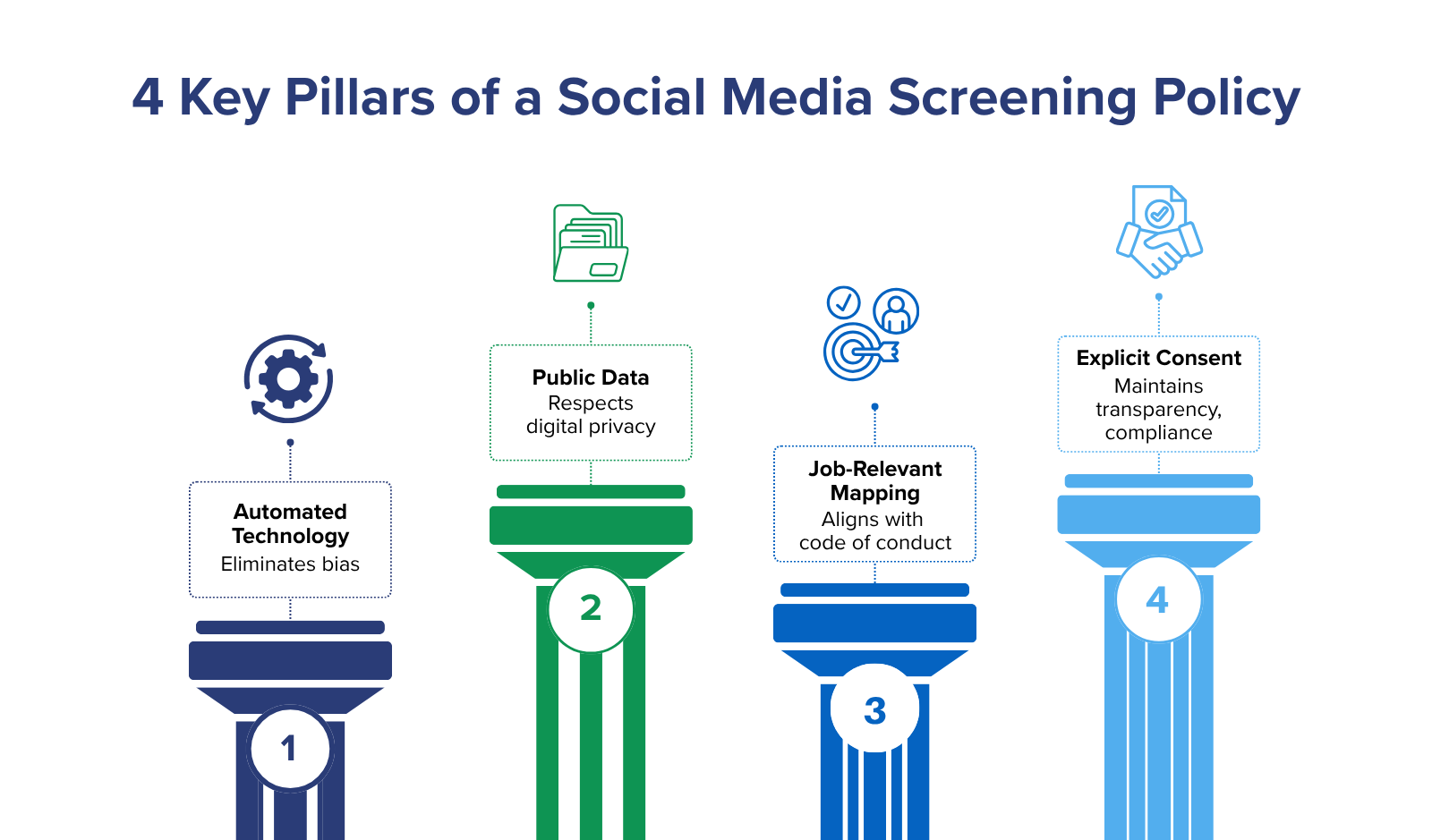
1. Automated Technology
The greatest risk of manual social media screening is the accidental exposure to protected class information. When a human reviewer looks at a candidate’s public profile, they instantly see data points like age, race, gender, religious affiliations, or physical health. Even the most well-intentioned hiring professional can’t completely remove unconscious bias once this information is seen, leaving the organization vulnerable to Title VII and EEOC discrimination claims.
A compliant policy mandates the use of automated screening technology. Instead of human eyes scouring the web, an AI-native platform acts as an objective filter, automatically redacting all protected information, identifying and extracting only the specific behavioral risks outlined in the screening policy. As a result, HR and Talent Acquisition teams receive a clean, redacted report containing only the behavior data relevant to the hiring decision, ensuring a fair and legal process.
2. Screening of Public Data
To align with privacy standards, the screening policy must clearly communicate that screening is restricted to public data only. This includes public posts, comments, images, and videos on accessible social profiles, forums, and online communities. If a candidate chooses to keep their profile or specific content private, that boundary must be respected. Restricting evaluation to the public domain ensures compliance with global privacy frameworks while evaluating the public footprint a candidate presents to the world and, by extension, the brand they represent.
3. Job-Relevant Mapping
Social media screening isn’t meant to judge a candidate’s or an employee’s lifestyle, political beliefs, or personal hobbies. A policy must ensure that online behavior is evaluated strictly through the lens of business risk and workplace safety.
Social media screening policies should map content to specific job-relevant risks, which directly connects online screening criteria to your company’s internal code of conduct and core values. By setting screening technology to only look for specific, actionable misconduct that could impact the workplace, such as explicit threats of violence, sexual harassment, illegal acts, or severe intolerance, businesses are ensuring that every flagged behavior has a direct impact on quality of hire and a candidate’s suitability for the role.
4. Explicit Consent for Screening
Transparency is the cornerstone of both candidate and employee trust. In addition to that, failing to provide clear written consent for social media screening is a violation of Fair Credit Reporting Act (FCRA) regulations, which dictate how consumer reports must be conducted during employment vetting.
A compliant policy requires explicit consent from the candidate before any background check or social media screening takes place. Obtaining written consent ensures full legal compliance, eliminates surprises, and sets a transparent standard for professional conduct.
Social Media Screening Policy Template
The difference between a high-performing talent screening strategy and a regulatory crisis comes down to your documentation. A vague, poorly defined screening policy creates operational friction and exposes your organization to immense legal liabilities.
Below is an actionable, structural blueprint designed to align candidate and employee evaluation with modern compliance standards, protect workplace safety, and safeguard corporate reputation. This framework acts as a guide for corporate policy documentation and should be customized to mirror your specific corporate code of conduct.
[Company Name] Social Media Screening Policies & Practices
How to Use This Template: The text below provides a baseline framework for a compliant, corporate social media screening policy. Bracketed text [like this] indicates placeholders where you should insert your organization's specific details, job titles, and unique code of conduct criteria. If using this structure for your company needs, be sure to review it with your legal team before final implementation.
1. Purpose and Scope
The purpose of this policy is to establish a standardized, legally compliant framework for conducting social media screening as part of [Company Name]’s social media screening and employee risk management program.
- Rationale: This policy is designed to protect workplace safety, ensure compliance with regulatory standards, protect corporate assets, and reduce the risk of hiring individuals whose public online conduct directly violates our workplace standards.
- Scope: This policy applies uniformly to all candidates undergoing pre-employment screening, as well as active employees subject to periodic rescreening, across all lines of business. It encompasses full-time, part-time, temporary, and off-payroll contract workers.
- Limitation: This screening is strictly behavioral. It is not used to evaluate personal, lawful opinions or lifestyle choices, but rather to identify credible, role-relevant risk signals.
2. Screening Methodology
To ensure fairness, eliminate subjective bias, and maintain regulatory compliance, all social media screening must adhere to the following procedural rules:
- Third-Party Isolation: All digital footprint and online behavior screening must be executed by [Company Name]’s authorized, FCRA-compliant third-party screening provider: [Screening Provider Name]. [Company Name] personnel, including recruiters and hiring managers, are strictly prohibited from conducting manual online searches ("Googling" or AI search) of candidates.
- Public Data Only: Screening is strictly restricted to publicly available online information. This includes public social media platforms, public blogs, open discussion forums, and public news or media sources.
- Privacy: [Company Name] will never request private social media passwords, demand access to private accounts, or utilize deceptive means (such as fake profiles or friend requests) to bypass a candidate's privacy settings.
3. Risk Identification
[Company Name]’s social media screening program is strictly focused on identifying specific behavioral risks that map directly to our corporate Code of Conduct. The automated screening solution is configured to extract and flag only the following occurrences:
- Violence and Threats: Direct intimidation, promotion of physical harm, or statements indicating an intent to cause a workplace threat.
- Intolerance and Hate Speech: Racist, sexist, bigoted, or discriminatory language targeting individuals or groups.
- Harassment and Trolling: Severe, repeated patterns of online bullying, aggressive behavior, or digital stalking.
- Illegal Activity and Asset Breaches: Digital evidence of fraud, theft, serious criminal conduct, or unauthorized leaks of proprietary/confidential company data.
3a. What is Not Included in Screening Reports
To ensure strict compliance with global fair hiring standards and to eliminate subjective biases, it is equally critical to define what our screening process excludes:
- Protected Class Information: Social media screenings by [Screening Provider] will automatically remove information regarding protected characteristics, including race, age, religion, gender, disability, and sexual orientation.
- Lawful Personal Opinions: The platform excludes candidate or employee personal opinions, lifestyle choices, and political beliefs that do not intersect with workplace risks.
- General Online Presence Levels: Vetting reports do not track or evaluate general activity metrics, such as how often a candidate posts, their follower counts, or their overall digital footprint volume, ensuring that candidates with and without active digital footprints are screened the same way.
- Private or Password-Protected Data: The screening technology entirely bypasses any digital information that is not available in the public domain. Private accounts, direct messages, hidden groups, deleted content, and password-protected profiles are outside the scope of the screening report.
4. Disclosure and Consent
Social media background checks will be performed with transparency and candidate rights.
- Mandatory Consent: Prior to initiating a check, the candidate must receive a disclosure confirming that their public online footprint will be reviewed. Written or digital authorization must be obtained.
- Consequence of Non-Consent: If a candidate chooses not to provide authorization for an online screening, [Company Name] will evaluate this decision within the context of the role's risk level. The [Talent Acquisition Director/Legal Partner] will determine if alternative due diligence steps can sufficiently satisfy the role's screening requirements.
5. Adjudication Guidelines
Findings surfaced in a screening report must be evaluated through an objective, consistent framework. The [Adjudication Manager / Review Committee] will evaluate flagged behaviors by weighing the following factors:
- Severity: The degree of risk or harm associated with the online conduct, categorized as minor, major, or significant concerns based on the nature of the behavior.
- Job-Relevance: The direct connection between the flagged online behavior and the specific duties, responsibilities, and safety requirements of the role.
- Recency: The age of the adverse findings and whether they represent a historical event or a modern pattern.
- Pattern vs. Incident: Whether the flagged content is an isolated occurrence or part of an ongoing pattern of adverse behavior.
- Context and Credibility: [Screening Provider] strictly limits data collection to verified, credible news sources and authentic candidate profiles. The review committee should analyze flagged content within the context of the text, image, and video from the sourced profile or article.
6. Adverse Action and Disputes
If a social media screening report reveals behavior that makes a candidate or employee unsuitable for a role, eligible for a verbal warning, or needing of a written reprimand, [Company Name] will follow legally mandated adverse action procedures:
- Pre-Adverse Action: For external candidates, if the company intends to rescind an offer based on a social media report, the candidate will be sent a Pre-Adverse Action notice, a copy of the screening report, and a summary of their rights under the FCRA. The company will review the individual's feedback, the recency of the posts, and the direct job-relevance before finalizing their hiring or lifecycle status.
- Dispute Window: The candidate will have [7] business days to dispute the findings, clarify identity attribution, or provide necessary context regarding the report.
- Internal Personnel Protocols: For active employees, verified behavioral risks may result in temporary work restrictions, requests to remove content, administrative leave, or formal termination depending on the severity of the threat.
7. Record Keeping and Data Security
- Secure Storage: All social media screening reports and final adjudication records will be securely housed in an encrypted database with role-based access restricted to authorized HR compliance personnel.
- Data Retention: Vetting documentation will be retained in accordance with [Regional Requirements] or corporate document retention schedules, after which the data will be permanently and safely deleted.
Partners in Social Media Screening Policy and Compliance
Building a strong social media screening policy doesn’t have to be a solo effort. While Fama provides state-of-the-art AI technology to safely surface behavioral risk signals, we know that true employee risk management requires more than just great software. It requires a partner.
That’s why Fama’s role goes beyond delivering automated misconduct reports. Our dedicated account managers and background screening compliance experts act as an expert extension of your HR teams, supporting you through policy creation and technical configurations that mirror your company code of conduct.
This combination of product expertise and deep client service is exactly why over 3,600 organizations rely on Fama to protect their workplace standards year after year.
Is your background screening process updated for the digital native workforce? Connect with the team at Fama today to get started.
Get the Newsletter
Recent Blog Posts
.jpg)
What is Identity Fraud in Hiring? What HR Needs to Know About Modern Employee Risk
.png)