Fama's White Glove Executive Vetting: The Difference Between Process Automation vs. Generative AI


AI is everywhere in executive search right now. It shows up in sourcing tools, interview note takers, your email, and every vendor pitch that lands in your inbox. For many search firm leaders, the question is no longer "Should we use AI?" It's "Which kind of AI actually helps us, and how much work will it take to get there?"
That question matters most in executive vetting. Your shortlist is your product. When a leader you place ends up in the headlines for past misconduct, your client doesn't just question the candidate. They question you, and ultimately your judgment.
The good news is that the right kind of AI can enhance executive vetting without lengthening the search process or requiring an IT or operations overhaul. The key is understanding the difference between generative AI and process automation AI, and knowing which one creates that white glove executive vetting experience and belongs in your due diligence.
Key takeaways:
- Generative AI creates new content. Process automation AI organizes and analyzes large amounts of existing, unstructured information.
- Executive vetting needs process automation, not generative AI, because accuracy and consistency matter more than creativity.
- The right partner handles the technology for you, so your recruiters and partners get the benefits without the lift.
- Fama's white glove executive vetting pairs proprietary process automation with expert human review and a simple onboarding process.
- We focus on vetting. You focus on decision-making.
What Is AI? What Executive Search Firms Need to Know
Artificial intelligence (AI) is technology that helps computers do tasks that usually take human thinking, such as reading, sorting, spotting patterns, and making sense of information. Not all AI works the same way, though. For executive search firms, the two types worth knowing are generative AI and process automation AI.
What is Generative AI?
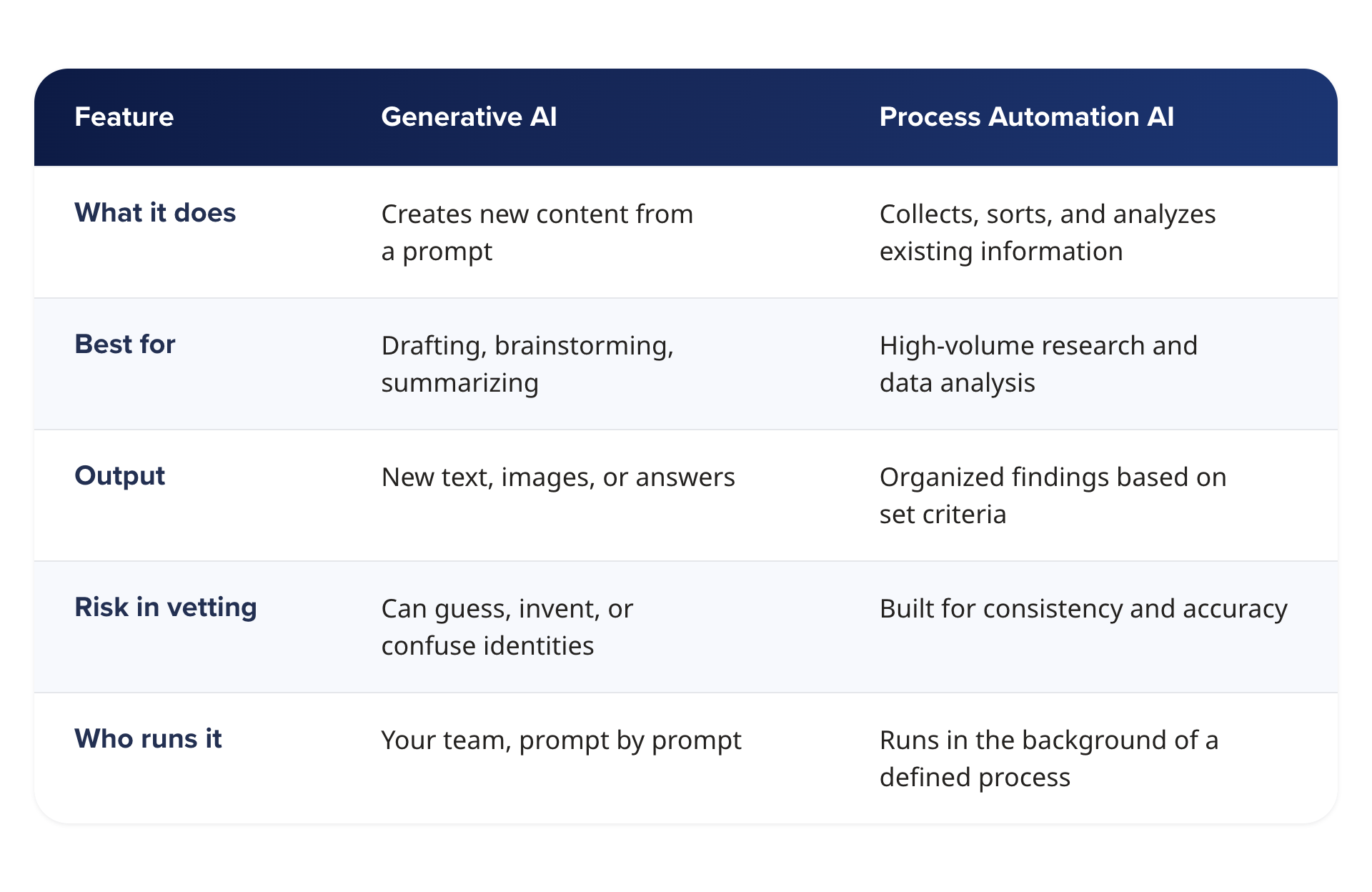
Generative AI is technology that creates new content based on a prompt. Tools like ChatGPT, Claude, and Gemini fall into this group. You ask a question or give an instruction, and the tool writes an answer, a summary, an image, or even code.
Generative AI is great for drafting outreach emails, brainstorming interview questions, or summarizing meeting notes. But because it produces new content, it can also get things wrong. It may mix up two people with the same name, fill in gaps with guesses, or state something false with total confidence. In executive vetting, where one mistake can cost a placement or a client relationship, that is a real risk.
What is Process Automation AI?
Process automation AI is technology that handles repeatable, rules-based work at a scale no person could manage alone. Instead of writing something new, it collects, sorts, and analyzes information that already exists, then flags what matters based on clear criteria.
Think of it as the difference between a writer and a researcher. Generative AI is the writer. Process automation AI is the tireless researcher who reads thousands of pages, organizes every finding, and hands you only what's relevant.
How Does AI Enhance White Glove Executive Vetting?
AI enhances executive vetting by reviewing far more public information than a person could, in a fraction of the time, and applying the same standards to every candidate.
Traditional executive due diligence leans on references, resume verification, interviews, and a hope that the client runs a background check. Those steps still matter. But today, many of the earliest warning signs live somewhere else: in public online activity, news coverage, and legal records.
That's a problem worth solving. Research from the Center for Creative Leadership, McKinsey, and Spencer Stuart shows that 30% to 50% of senior executive hires derail, underperform, or exit within 18 to 24 months. Many of those exits come down to behavior, judgment, and ethics, not a lack of skill.
Here's where process automation AI helps executive search firms:
- Depth: It reviews a candidate's public online presence, including text, images, and video, across thousands of sources. It also checks sanctions, watchlists, and international news sources.
- Speed: It completes in 3 days what could take a researcher weeks of manual searching.
- Consistency: It applies the same criteria to every candidate, which closes the gap where firms vet some candidates heavily and others lightly.
- Client confidence: With AI tools in every client's hands, a quick prompt can surface adverse news in seconds. Automated vetting helps make sure your firm finds it first.
What Executive Vetting AI Is (and Isn't)
When search firm leaders hear "AI," many picture a new platform to learn, a login for every recruiter, and a long IT project. The right executive vetting AI looks nothing like that. Here's what it is and what it isn't.
What Executive Vetting AI Is: Process Automation
Executive vetting AI is process automation that works through a huge amount of public information and turns it into clear, organized findings. It does the heavy lifting so your people don't have to. Combined with Fama’s access to critical sources of information and our ability to dive deep into behavior insights, your firm benefits through:
- Data analysis at scale. Review a candidate's full public footprint, not just the first couple pages of search results.
- More insights, less noise. More comprehensive vetting, with insights categorized for your team to make easy shortlisting decisions.
- Comprehensive vetting in 3 days. No manual searches, and relevant insights in as little as 3 business days.
- Reduced workloads. Your research team spends less time on manual searches and more time on high-value work.
- Stronger compliance. A structured, consistent process supports FCRA, GDPR, and other relevant requirements.
The benefits for your people:
- Your recruiters get deeper insights on every candidate without adding work to their day. They see the results, not the lift.
- Your partners can stay focused on what grows the firm: client relationships and business development. They walk into client conversations with a shortlist they can stand behind.
What Executive Vetting AI Isn’t
Just as important is what executive vetting AI should not be.
- It isn't generative. It doesn't write guesses or invent findings. Every flag ties back to real, public information about the right person.
- It doesn’t require time-consuming admin. Your team doesn't need to write prompts, check outputs, or build reports by hand.
- It isn't an IT project. Your IT team doesn't need to implement, integrate, or maintain new AI systems.
- It isn't another tool to manage. You don't need to hire an operations manager or assign someone to run the software.
In short, you get the value of AI without taking on the risks or the work of running it yourself.
How Fama's Proprietary AI Supports Executive Vetting With a White Glove Approach
Fama built its executive vetting service for firms that want modern due diligence without changing how they work. We call it white glove because we handle the process from start to finish, and your team simply receives the results.
Fama's Proprietary Process Automation
Fama's AI-native platform analyzes text, images, and video across a candidate's public online presence to surface workplace-relevant behavior risks, such as harassment, threats, violence, and other misconduct. Here's what sets our approach apart:
- Identity you can trust. Fama confirms each profile using at least three unique identifiers, so findings belong to the right person. No guessing and no mistaken identity.
- Human review on every report. Our AI flags potential risk, and trained analysts review each report to remove false positives before it reaches you.
- Compliant by design. Fama is built to align with the FCRA, GDPR, and global data privacy frameworks.
- Support for human judgment. Fama doesn't score or rank candidates, and it doesn't make placement decisions. We give your team clear, relevant findings so you can make the call.
What Working with Fama Looks Like
Getting started is simple, and your team stays focused on search.
1. Onboarding meeting. We meet with your team to learn your firm, your clients' standards, and what matters most in your vetting process.
2. Fama does the work. Our proprietary process automation and expert analysts review each candidate's public online footprint.
3. You receive the report. Your team gets a clear, organized report on each candidate. A comprehensive Fama 360 executive due diligence report may come back in as little as 72 hours.
No software integrations, no IT tickets and no extra headcount required.
Why Search Firms Choose Fama
Fama is the world's leading AI-driven executive vetting solution, trusted by more than 3,600 companies and best-in-class executive search firms. For firms, that means you partner with a solution provider who understands both your needs and the stakes. When your name is on the shortlist, you need vetting that is thorough, consistent, and ready to hold up in front of a board.
Ready to see white glove executive vetting in action?
Request a demo today.
FAQ: AI and Executive Vetting for Search Firms
What is executive vetting?
Executive vetting is the process of reviewing a leadership candidate's background, history, and behavior before a placement. Modern executive vetting goes beyond references and resume checks to include public online activity, news, and legal records.
What is the difference between generative AI and process automation AI?
Generative AI creates new content, such as text or images, based on a prompt. Process automation AI collects, sorts, and analyzes existing information at scale using set criteria. Executive vetting relies on process automation because accuracy matters more than creativity.
Is it safe to use generative AI tools like ChatGPT for executive due diligence?
Generative AI tools can be helpful for research ideas, but they can mix up identities, miss context, or state false information with confidence. They also aren't built to follow FCRA consent and review requirements. For executive due diligence, firms should use a compliant, purpose-built process with human review.
Do executive search firms need IT support to use AI for vetting?
Not with a white glove partner like Fama. Fama handles the technology, the analysis, and the human review. Your team attends an onboarding meeting, tells us who to screen, and then receives finished reports, with no IT implementation or new software to manage.
How long does a Fama executive vetting report take?
A comprehensive Fama 360 executive due diligence report may be delivered in as little as 72 hours.
Get the Newsletter
Recent Blog Posts
.png)
Fama's Favorite Influencers: 11 HR Experts You Need to Follow in Q3 2026
.jpg)